
Strength Is Protective — But Only When It’s Trained Properly
Injury prevention has become one of the most confused ideas in modern fitness.
Depending on who you follow online, avoiding injury supposedly requires endless stretching, corrective exercises, balance drills, mobility flows, or “bulletproofing” routines that never actually involve lifting anything heavy.
Yet despite all this caution, injury rates remain high.
The reason is simple and uncomfortable:
most people aren’t injured because they move too much — they’re injured because they’re underprepared for the demands placed on them.
Strength, when trained correctly, is one of the most powerful protective tools we have.
Where the “Strength Is Injury Prevention” Claim Comes From
Recently, a set of statistics has been circulating online showing that strength training reduces injury risk far more than stretching, proprioception, or mixed programmes. These numbers are not made up.
They originate from a large systematic review published in the British Journal of Sports Medicine, which analysed multiple controlled trials examining exercise-based injury prevention.
The key finding was clear: progressive strength training consistently produced the largest reduction in injury risk when compared to other single-modality approaches.
This does not mean strength eliminates injuries. It means that, statistically, people who train strength appropriately are far more resilient when exposed to physical stress.
Why Strength Is Fundamentally Protective
Strength is not just about muscles or lifting numbers. It is a whole-system adaptation.
As strength improves, muscles become better at absorbing force, tendons adapt to transmit load more efficiently, bones increase in density, and joints gain stability under movement. The nervous system also becomes more confident at producing and controlling force, even when tired or off-balance.
This is why stronger people tend to:
Tolerate higher workloads
Recover faster from flare-ups
Break down less under fatigue
Cope better when movement isn’t perfect
Life does not happen in ideal positions. Strength provides a buffer — a margin for error.
That buffer is what people often mistake for “injury resistance”.
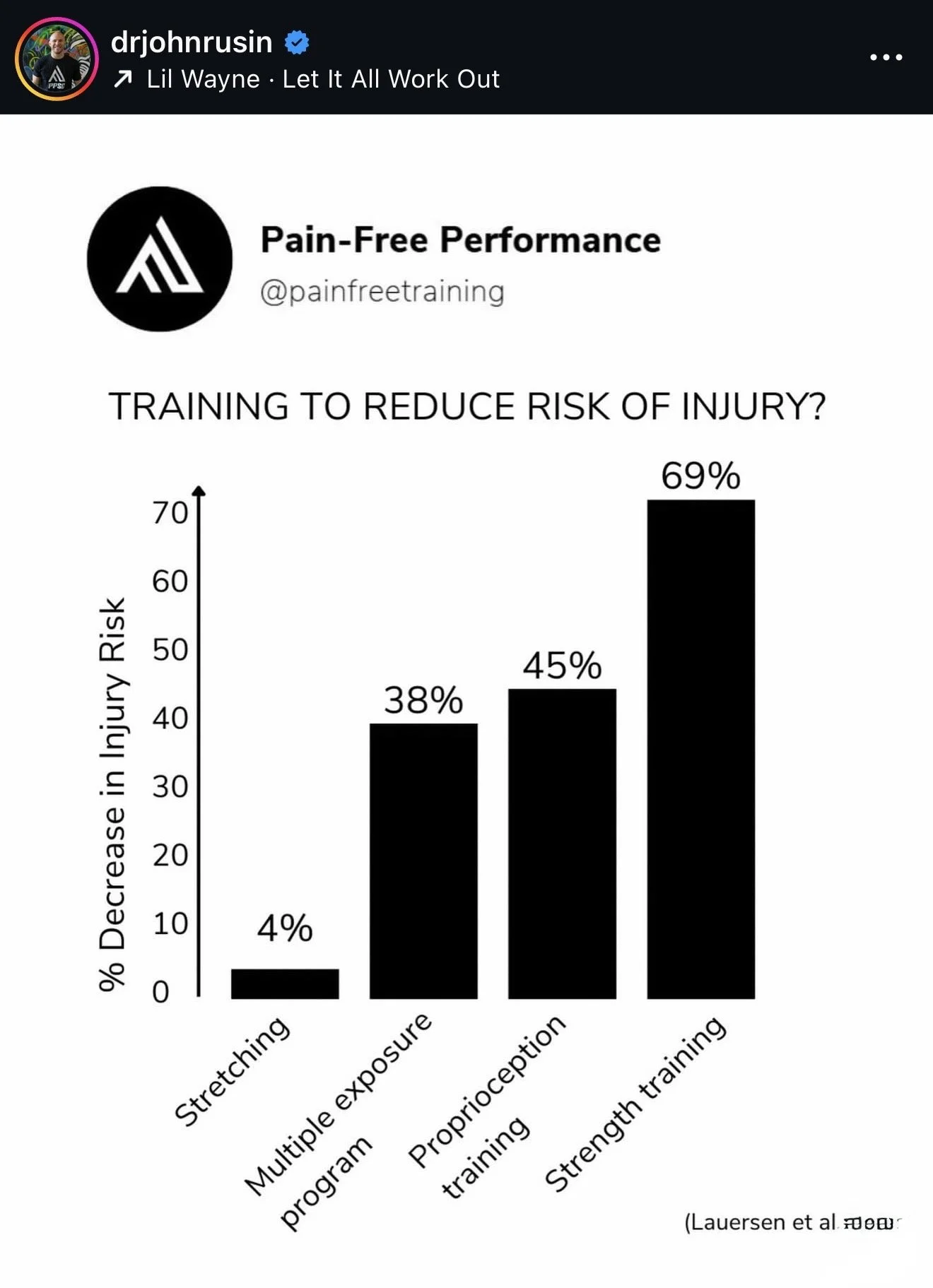
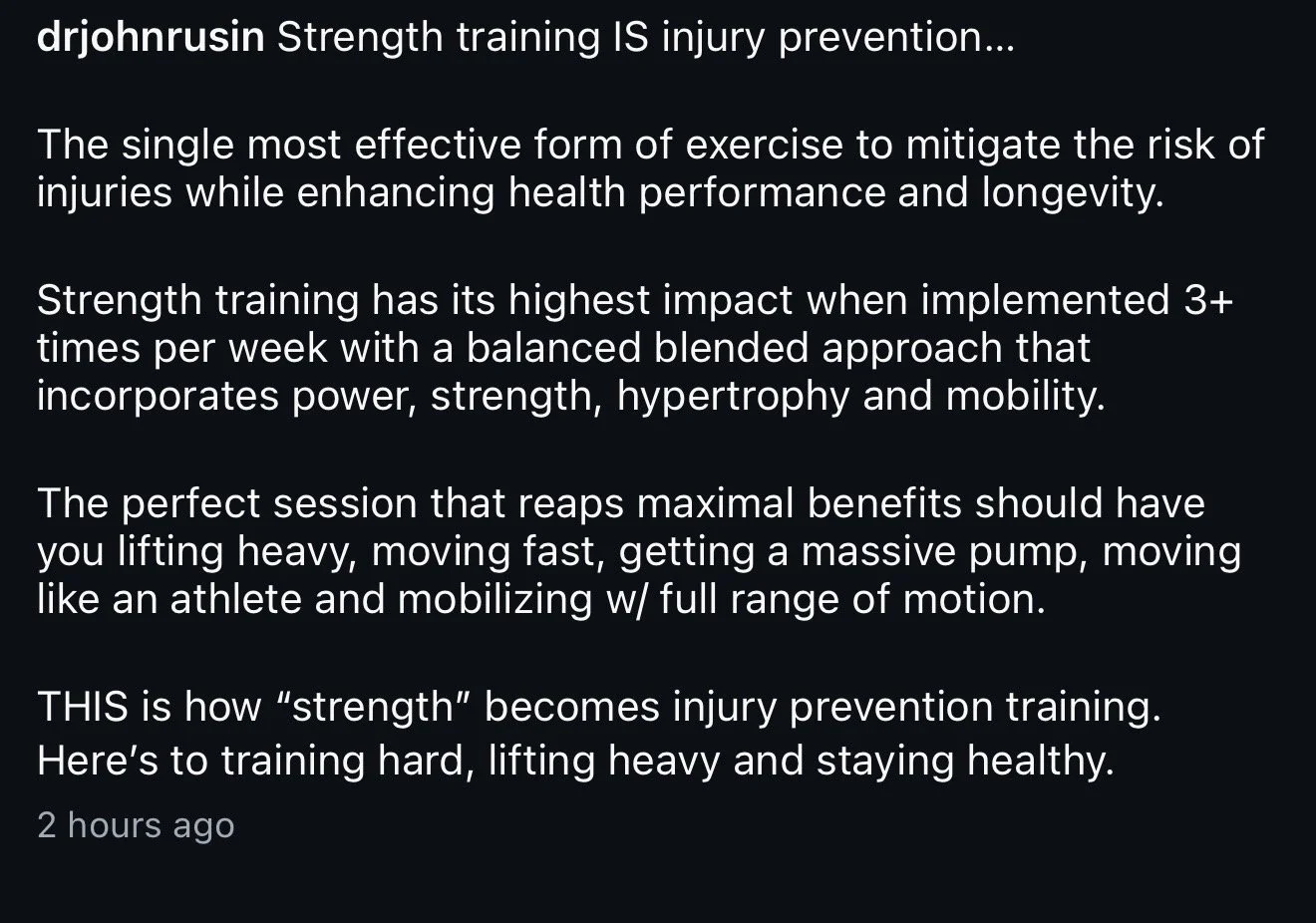
What the Instagram Posts Get Right — and Wrong
The viral takeaway — “Strength training is the best form of injury prevention” — is directionally correct.
Where things go wrong is in how strength is defined and applied.
Strength is often reduced to gym numbers: squat, bench, deadlift. While these lifts can be valuable tools, they are not a complete expression of strength, nor are they automatically protective.
You can be strong in controlled gym conditions and still be fragile in real life.
True injury-resilient strength is not about a barbell total. It is about capacity across positions, ranges, directions, and fatigue states.
What the Research Actually Shows (in Plain English)
When stripped of academic language, the evidence consistently points to this hierarchy:
Stretching alone has little to no meaningful effect on injury risk
Balance or proprioception training helps, but only to a point
Mixed programmes offer moderate benefit
Progressive strength training produces the largest and most consistent reduction in injury risk
This aligns with what experienced coaches and clinicians see daily:
mobility without strength doesn’t hold, and control without capacity breaks down.
Why Avoiding Load Often Makes Things Worse
A common response to injury or pain is to “protect” the area by avoiding load. While this may feel sensible short-term, it often backfires.
Tissues adapt to stress — or they decondition.
When load is avoided for too long:
Muscle strength declines
Bone density reduces
Tendons lose tolerance
Everyday tasks feel threatening
Eventually, even normal movement can provoke pain — not because it’s dangerous, but because the system has lost capacity.
Progressive loading is not reckless. It is how resilience is rebuilt.
Strength for Longevity, Not Ego
As we age, strength becomes more important, not less.
Loss of strength is one of the strongest predictors of falls, loss of independence, chronic pain, and reduced quality of life. Injury prevention in later life is not about avoiding challenge — it’s about remaining capable.
Strength training, when applied intelligently, allows people to:
Maintain confidence in movement
Recover faster from setbacks
Continue sport, hobbies, and daily life
Age with independence rather than fragility
This is particularly relevant for adults over 40, 50, and beyond — where the goal is not peak performance, but sustained capability.
Why “Corrective Exercise” Isn’t Enough
Mobility work, activation drills, and rehabilitation exercises have a place. But they are not substitutes for strength.
Without progressive loading:
Mobility gains are temporary
Pain relief doesn’t last
Movement confidence remains fragile
Rehabilitation doesn’t end when pain disappears.
It ends when capacity is restored.
Strength is what makes improvements durable.
How We Apply This at Poseidon Performance
At Poseidon Performance, strength is trained with purpose — not ego.
Every programme considers:
Injury history
Age and recovery capacity
Lifestyle and stress load
Movement demands of daily life or sport
Strength is developed across fundamental patterns, challenged in varied positions, and progressed in a way that builds long-term resilience rather than short-term numbers.
The aim is simple:
make you harder to injure by making you more capable.
Key Takeaways
Strength training is the most effective single tool we have for reducing injury risk
The protection comes from increased capacity, not perfect movement
Strength must be trained across ranges and contexts to be truly protective
Avoiding load long-term increases vulnerability, not safety
Longevity depends on strength more than any other physical quality
Final Thought
Injury prevention is not about avoiding stress.
It is about being prepared for it.
Strength, when trained properly, is not dangerous.
It is protective.
And over the long term, it is one of the most reliable investments you can make in your health, resilience, and independence.
