
The Science of Spotting: Why Just Touching the Bar Can Make a Heavy Lift Feel Easier
The psychology, biomechanics and neuromuscular science behind one of the most misunderstood aspects of strength training.
You've probably experienced it.
You're bench pressing a heavy weight. The first few repetitions move well, but then the bar begins to slow.
You grind through another repetition.
Then you reach that familiar sticking point.
The bar almost stops.
Your spotter reaches forward and places two fingertips beneath it.
Suddenly, the bar starts moving again.
You finish the repetition, convinced your spotter has practically lifted the weight for you.
But they insist:
"I barely touched it."
And here's the interesting part.
They might be telling the truth.
Because the difference between completing a heavy lift and failing it can be remarkably small.
Sometimes, just a few newtons of additional force are enough to change the outcome.
But there's more happening than simply making the weight lighter.
We're dealing with biomechanics, force production, sensory feedback, perception of effort and the psychology of having someone there to help.
Understanding this can completely change how you approach spotting, particularly when coaching strength development.
1. The sticking point: When the bar suddenly feels impossible
During a heavy bench press, the force you're capable of producing changes throughout the movement.
Your muscles don't generate identical force at every joint angle.
Neither do the mechanical demands remain constant.
As the bar moves upwards, changes in shoulder and elbow position affect muscle length, moment arms and the force required from the involved muscle groups.
At certain points, your ability to generate upward force may approach the force required to keep the bar moving.
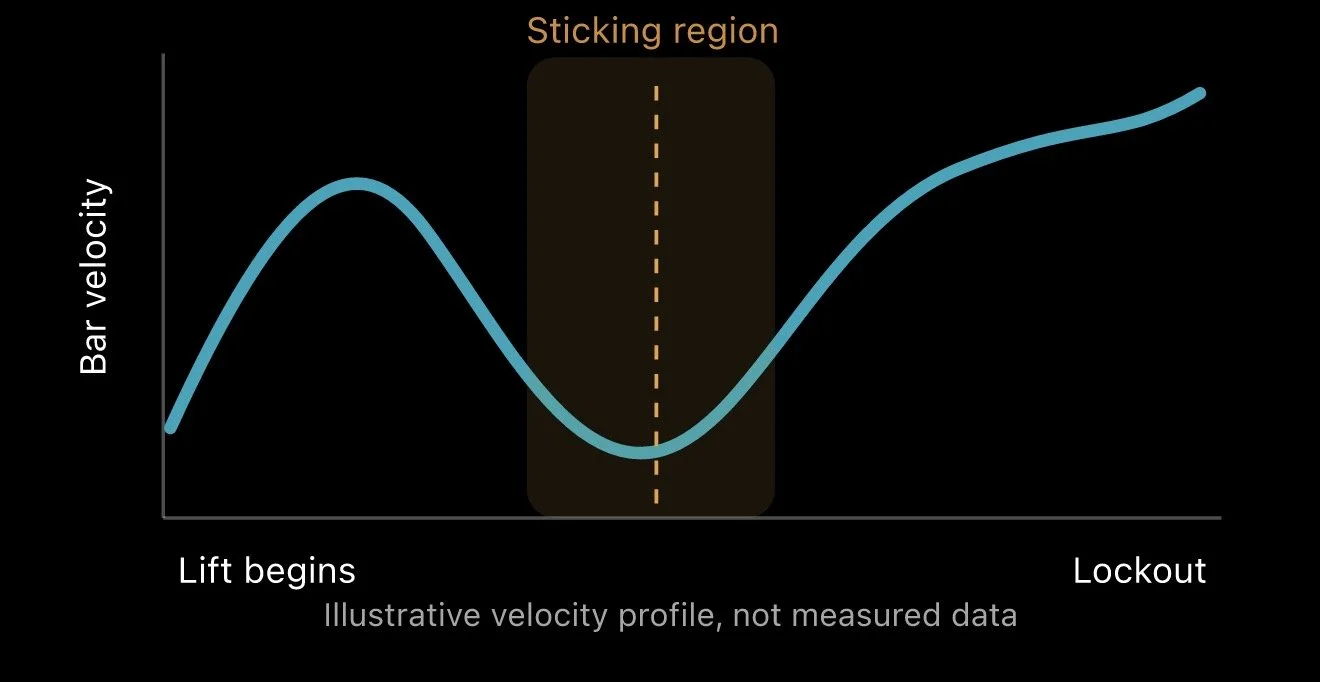
This is commonly called the sticking region.
And it's where something interesting happens.
Imagine you're pressing a 100 kg barbell.
ILLUSTRATIVE EXAMPLE
Barbell weight force
981 N
Lifter's upward force
976 N
At that instant, the lifter is producing slightly less upward force than the gravitational force acting on the bar.
The result?
The bar begins to decelerate.
Now imagine the spotter adds just 10 newtons of upward assistance.
That's approximately equivalent to supporting 1 kg of weight.
Suddenly, the combined upward force exceeds the weight of the bar.
The bar begins accelerating upwards again.
The spotter hasn't lifted 100 kg. They've provided the small amount of additional force needed to change the movement.
This is the fundamental mechanical principle behind effective spotting.
And it's why the lightest touch can sometimes make an enormous difference.
2. Why keeping the bar moving makes such a difference
Here's where spotting becomes particularly interesting.
A barbell doesn't need to be accelerating upwards throughout the entire repetition to complete a lift.
It can slow down considerably and still be moving upwards.
And that distinction is important.
Newton's second law explains the relationship:
When the lifter produces less upward force than the downward gravitational force, the bar decelerates. But if it already has upward velocity, it doesn't immediately stop.
It continues travelling upwards until that velocity is exhausted.
What happens during a heavy repetition?
During the sticking region, bar velocity falls dramatically. Research by van den Tillaar and Ettema documented this characteristic deceleration during maximal bench pressing.
A skilled spotter can provide just enough assistance to prevent the bar from stopping or reversing direction.
That small contribution may allow the lifter to move through the mechanically challenging region and continue the repetition.
The spotter is not necessarily doing much of the work. They're helping the lifter overcome a temporary force deficit.
There is an important distinction, however: once the spotter contributes force, the repetition is assisted. It shouldn't be counted as an unassisted personal best.
3. The psychology of touch: Why the bar can suddenly feel lighter
Now we reach the part that fascinates me most as a coach.
Sometimes a lifter reports that the moment a spotter touches the bar, the entire movement feels easier.
There are several plausible explanations.
Sensory feedback
Our nervous system continuously integrates information from our muscles, joints, skin and visual system.
This information helps us estimate limb position, movement, force and stability.
A light touch can change that sensory information.
Research into haptic feedback demonstrates that fingertip contact with a stable external surface can improve postural control, even when the applied force is too small to provide meaningful physical support.
However, this research primarily concerns balance and postural stability, not spotting heavy barbells.
We cannot automatically conclude that fingertip contact produces the same neurological effect during a maximal bench press.
Nevertheless, it provides an interesting explanation worth investigating.
The sensation of contact may alter the lifter's perception of stability and control.
Confidence and perceived effort
There is also a psychological component.
A heavy repetition can create uncertainty.
Will I complete it?
Am I about to fail?
Will I get trapped under the bar?
When a trusted spotter makes contact, some of that uncertainty may disappear.
The lifter knows assistance is available.
That reassurance may change their willingness to continue applying effort.
It doesn't necessarily increase their maximum muscular force-producing capacity. But it may influence how confidently they express the strength they already possess.
Importantly, this is a plausible mechanism, not proof that touching a bar automatically improves neural drive.
Actual mechanical assistance
And finally, we cannot overlook the obvious.
Even a light touch can provide meaningful mechanical assistance at the precise moment it's needed.
The lifter might genuinely feel as though the spotter has taken over because the bar has suddenly started accelerating again.
Their perception of the amount of assistance isn't a reliable measurement of the force the spotter applied.
Neither is the spotter's perception.
Without measuring that force, neither person knows exactly how much help was given.
4. The art of spotting: Knowing when to help and when to leave the bar alone
This is where coaching experience becomes important.
An inexperienced spotter often makes one of two mistakes.
They either intervene too early, removing the training stimulus, or wait too long, allowing the lifter to lose control.
A skilled spotter understands the difference between a slow repetition and a failed repetition.
A heavy bar moving slowly is not necessarily a problem.
In fact, during high-intensity strength training, slow concentric velocities are entirely expected.
Slow doesn't mean failed.
A lifter grinding through the sticking region may still be capable of completing the repetition independently.
Intervening simply because the bar slows can prevent them from developing confidence and experience under heavy loads.
But there's another side.
Allowing someone to continue fighting a repetition after they've lost control can introduce unnecessary risk.
The skill lies in recognising the difference.
5. How much assistance should a spotter actually give?
There isn't one universal answer.
It depends on the exercise, training objective, experience of the lifter and whether assisted repetitions are planned.
For an unassisted maximal strength attempt, the objective is straightforward: the spotter provides no assistance unless needed for safety.
For a planned assisted repetition, the objective may be different.
The coach might deliberately provide the minimum assistance needed to complete the concentric phase while maintaining technique.
The difference between assistance and taking over
The distinction is particularly relevant in strength coaching.
If a lifter performs five repetitions independently and requires assistance on the sixth, that sixth repetition isn't equivalent to the previous five.
It's an assisted repetition.
That doesn't make it worthless.
It simply means the training stimulus and performance outcome should be described accurately.
6. Why experienced coaches develop a feel for the bar
Good spotting is partly an exercise in force regulation.
The coach watches the lifter's technique, bar path and velocity while maintaining awareness of fatigue and control.
When contact is necessary, they adjust their assistance in response to what the bar is doing.
Too little assistance and the bar continues to descend or stall.
Too much assistance and the coach effectively completes the repetition.
The ideal amount, when a deliberately assisted repetition is appropriate, is enough to support safe movement without unnecessarily removing effort from the lifter.
That requires coordination between two people.
And it explains why a highly experienced coach may provide extremely subtle assistance that feels far more substantial to the lifter than it actually is.
But it's also important to understand the limitations.
A fingertip is not a reliable rescue strategy for a genuinely failed heavy bench press.
Heavy lifting requires appropriate safety equipment, suitable spotter positioning and the ability to take control of the full load when necessary. Spotters should never rely on a two-finger technique to catch a falling bar.
7. What this means for strength development
At Poseidon Performance, I want people to understand what they're doing, not simply complete repetitions.
When coaching heavy strength work, the objective isn't to make every repetition look easy.
It's to create the appropriate stimulus while managing risk.
That means understanding when a lifter needs encouragement, when they need assistance and when a set should finish.
There's a considerable difference between helping someone complete a difficult repetition and disguising the fact that they've reached failure.
Both the coach and athlete should understand that distinction.
Because genuine strength development requires honest feedback.
If the coach is constantly lifting the bar, the athlete isn't necessarily becoming stronger.
But if the coach intervenes appropriately, assisted repetitions can have a place within a structured programme.
The key is intent.
The final takeaway: Sometimes the smallest force makes the biggest difference
The next time you're struggling with a heavy bench press and your spotter touches the bar, pay attention to what happens.
The bar may suddenly begin moving again.
It might feel as though your spotter has lifted half the weight.
But mechanically, they may have contributed only a small amount of additional force at exactly the right moment.
That small contribution can change the balance of forces, preserve upward movement and help you pass through the sticking region.
Combine that with the potential influence of touch, confidence and perceived control, and you begin to understand why spotting is more sophisticated than simply standing behind someone waiting for them to fail.
The best spotting isn't about how much weight the coach can lift. It's about understanding how little assistance is needed—and precisely when it's appropriate to provide it.
That's the difference between someone who simply spots and someone who understands the science of strength coaching.
Research supporting the article
Van den Tillaar, R. & Ettema, G. (2010). The sticking period in a maximum bench press. Journal of Sports Sciences.
Kompf, J. & Arandjelović, O. (2016). The Sticking Point in the Bench Press, the Squat, and the Deadlift. Sports Medicine.
Evangelista et al. (2025). Decoding the Contribution of Shoulder and Elbow Mechanics to Barbell Kinematics and the Sticking Region.
Rabin et al. (2008). Influences of arm proprioception and degrees of freedom on postural control with light touch feedback. Journal of Neurophysiology.
