The Truth About Healing: Why Recovery Takes Longer Than You Think
Introduction
“Pain-free” doesn’t mean “problem-free.”
Many people stop their rehab as soon as the pain eases, only to relapse weeks later. The truth is, pain is just one piece of the puzzle, your body follows a structured, biological process of repair, and each tissue has its own timeline.
At Poseidon Performance, we guide clients through recovery using science, not shortcuts, rebuilding strength, confidence, and resilience every step of the way.
1. The Phases of Healing
Every injury follows a predictable sequence of biological events. Knowing these helps you understand what your body needs and when.
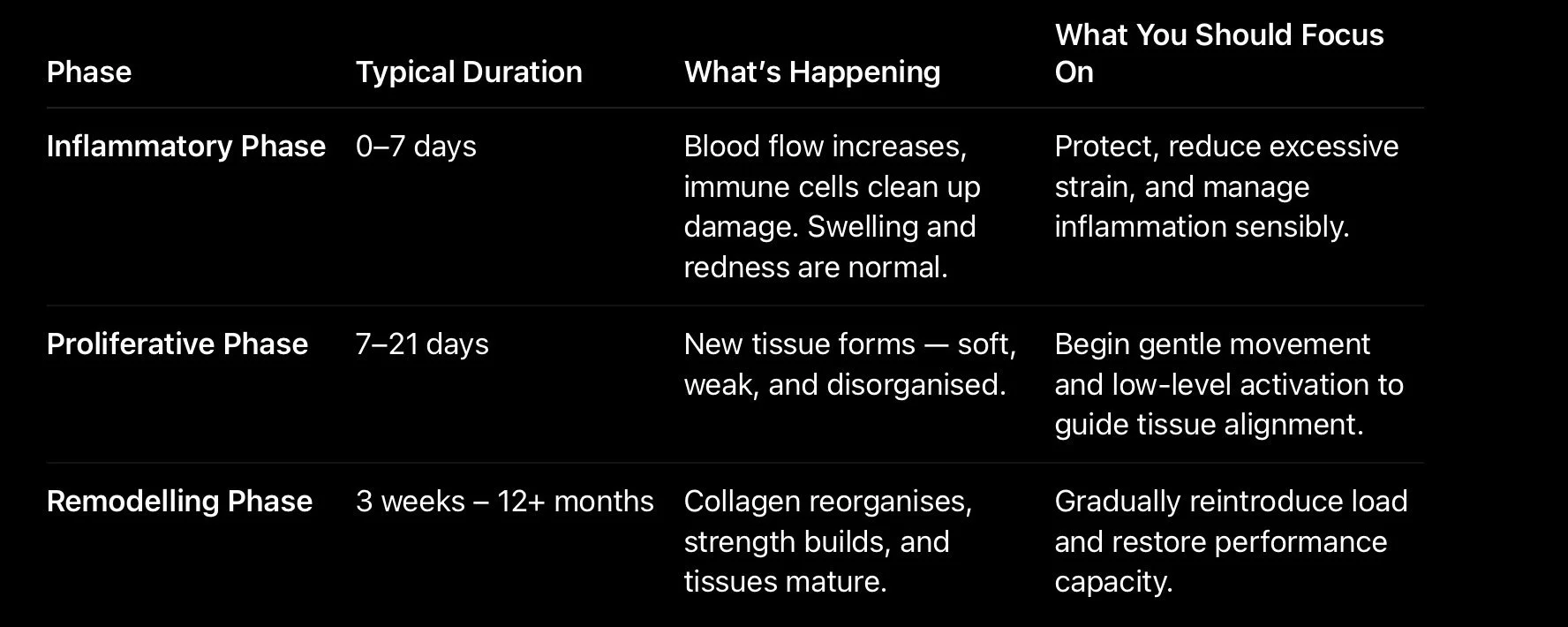
Recovery doesn’t stop when pain disappears it continues until the tissue can handle life, sport, and load again.
2. How Each Tissue Heals and Why It Matters
Muscles
Timeline: 2–8 weeks (minor) to 3–6 months (severe)
Key Point: Muscles heal faster due to good blood supply, but need progressive load to realign fibres.
Common Mistake: Overstretching too early can delay recovery.
Tendons
Timeline: 3 weeks to 12+ months
Key Point: Poor circulation and high stress loads make tendons slow to repair.
Best Practice: Controlled, heavy–slow resistance training stimulates collagen remodelling.
Ligaments
Timeline: 4 weeks to 1+ year (depending on grade)
Key Point: Ligaments provide joint stability — they need time to rebuild tensile strength.
Best Practice: Proprioceptive and stability training are critical before impact or change-of-direction work.
Bones
Timeline: 6–16+ weeks
Key Point: Bone healing is well-vascularised but still requires patience before impact loading.
Best Practice: Gradual reloading under supervision once medical clearance is given.
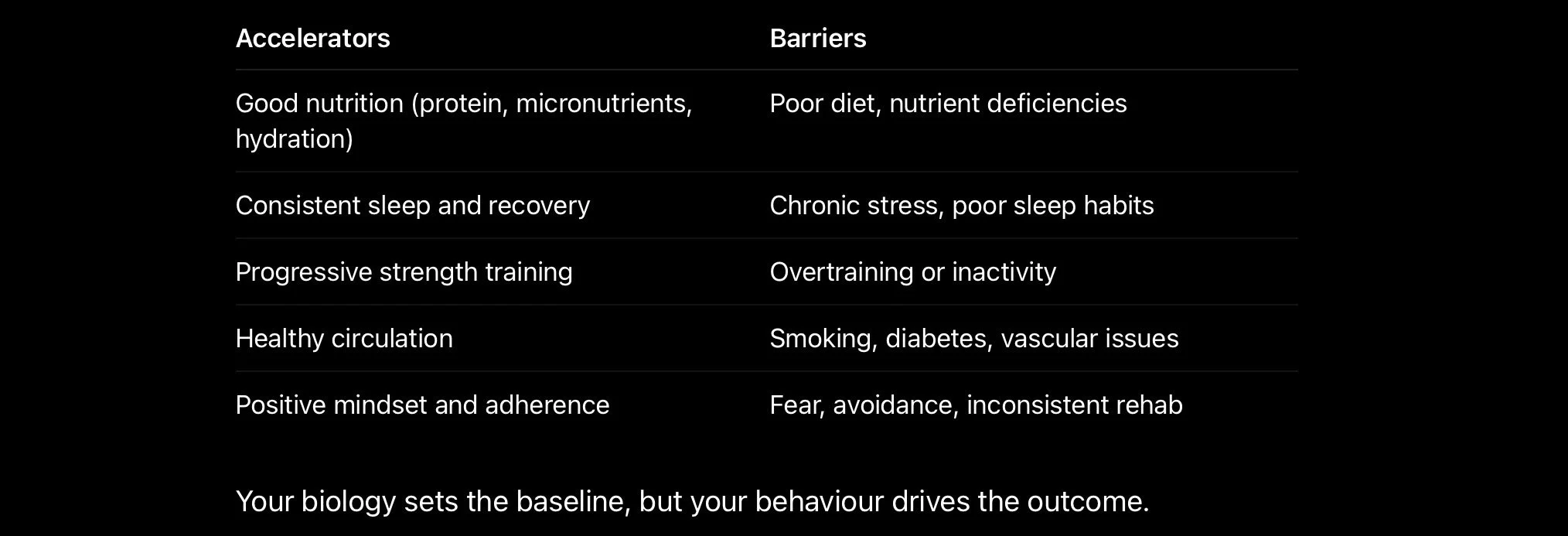
3. Why Healing Speed Varies So Much
Two people with the same injury can recover months apart. Here’s why:
4. Pain Relief ≠ Recovery
Pain is a symptom, not a milestone.
When discomfort fades, many assume they’re ready for full training but tissues are still fragile. True recovery means your body can tolerate load without structural strain or movement compensation.
Stopping too early leads to:
Weakened tissue integrity
Poor motor control and balance
Recurrent injuries in the same or surrounding areas
At Poseidon, we ensure each client earns their return-to-play through measurable strength, mobility, and control benchmarks.
5. The Safe Progression from Pain to Performance
Phase A: Protection & Early Healing (Days 0–7)
Respect pain and avoid aggravation.
Use gentle movement to maintain circulation.
Begin guided isometrics if appropriate.
Phase B: Repair & Rebuild (Weeks 1–6)
Controlled mobility and low-intensity strength work.
Gradually restore range, alignment, and stability.
Phase C: Strength & Conditioning (Weeks 6–16+)
Introduce progressive overload and sport-specific drills.
Address imbalances and motor control deficits.
Phase D: Performance Integration
Load testing, resilience building, and maintenance programming.
Final benchmarks before full return to sport or activity.
6. How Poseidon Performance Makes the Difference
Rehab at Poseidon isn’t about “doing exercises” it’s about rebuilding capability.
Comprehensive assessment: We identify tissue integrity, neuromuscular control, and limiting factors.
Structured progression: No generic timelines just evidence-based loading plans.
Integrated strength systems: We bridge the gap between clinic and performance.
Accountability: Measured outcomes ensure each stage is earned, not guessed.
Long-term support: Our goal is not short-term relief it’s lifelong resilience.
Pain going away is just the beginning. Real recovery means strength, stability, and confidence to live fully again.
7. Frequently Asked Questions (FAQ)
How long does it take to fully recover from an injury?
It depends on the tissue type, severity, and how well you follow your rehab plan. Muscles may heal in weeks, tendons and ligaments in months, and bone remodelling can take up to a year.
Can I train while injured?
Yes — when done correctly. Our approach focuses on training around the injury, maintaining strength and conditioning safely while supporting healing.
Why does my pain come back even after rest?
Because rest doesn’t rebuild resilience. Without structured loading, tissues don’t regain full capacity and remain vulnerable when stressed again.
What’s the difference between rehab and physiotherapy?
Rehab at Poseidon Performance goes beyond symptom treatment. We integrate physiotherapy principles with strength & conditioning, bridging the gap between healing and high performance.
How do I know I’m ready to return to full activity?
We test it — not guess it. Benchmarks include strength symmetry, full range of motion, stability, and the ability to perform sport-specific tasks without pain or compensation.
What if I’ve had an old injury that never felt quite right?
Chronic or poorly rehabbed injuries can be reconditioned. Our specialists retrain the movement patterns, rebuild tissue tolerance, and restore full function.
8. Call to Action
Ready to rebuild properly not just rest and hope?
Book a Free Recovery Strategy Session with Poseidon Performance.
Our experts will assess your current stage, design a progressive loading plan, and guide you from pain to peak performance.
