
The Real Cause of Strength and Muscle Loss as We Age
Most people assume strength loss is an unavoidable part of getting older.
You hit your 40s, things start to ache, lifts feel heavier, recovery takes longer — and the conclusion seems obvious: this is just what ageing looks like.
But when you look at the data properly, age itself isn’t the cause.
The real driver is something far more mundane — and far more controllable.
It’s the gradual loss of stimulus.
What Happens to Strength Across the Lifespan
Large population studies examining strength across decades paint a surprisingly consistent picture.
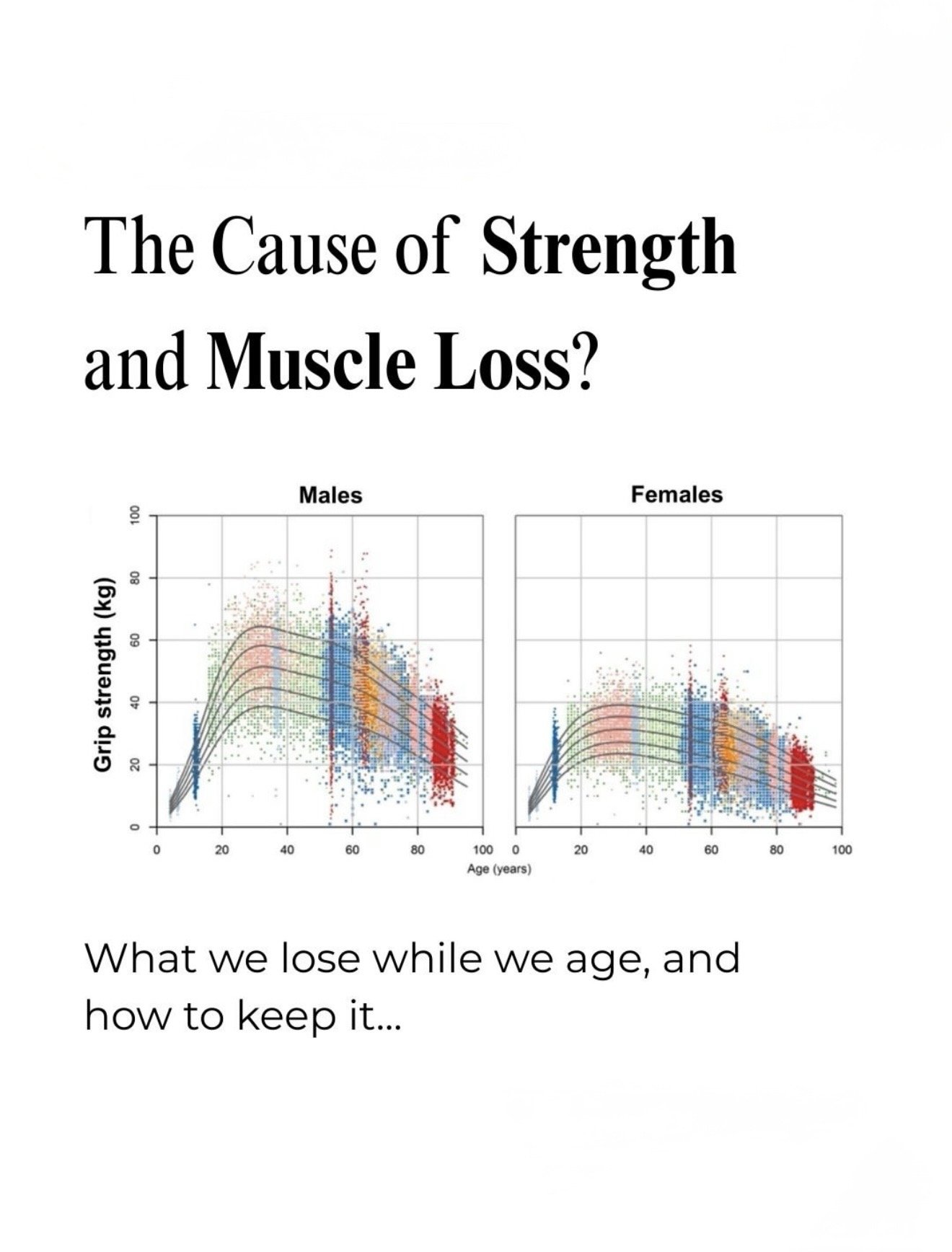
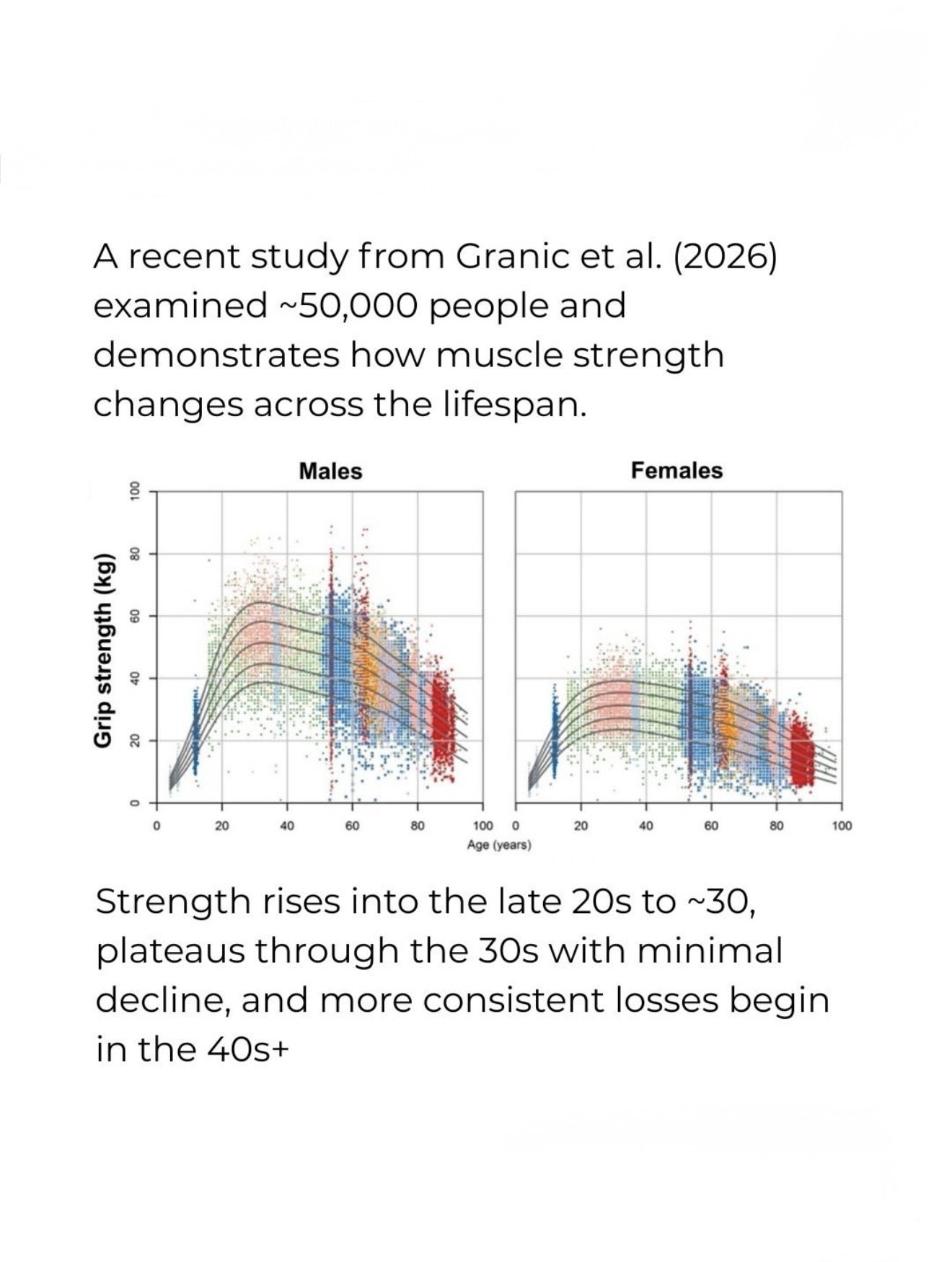
When grip strength data from tens of thousands of individuals is plotted against age, the trend is clear in both men and women:
Strength rises steadily through childhood and adolescence, peaks somewhere in the late 20s to early 30s, then holds relatively steady through much of midlife. More noticeable declines tend to begin from the 40s onward.
At first glance, this looks like confirmation that ageing causes weakness.
But look closer, and something far more important appears.
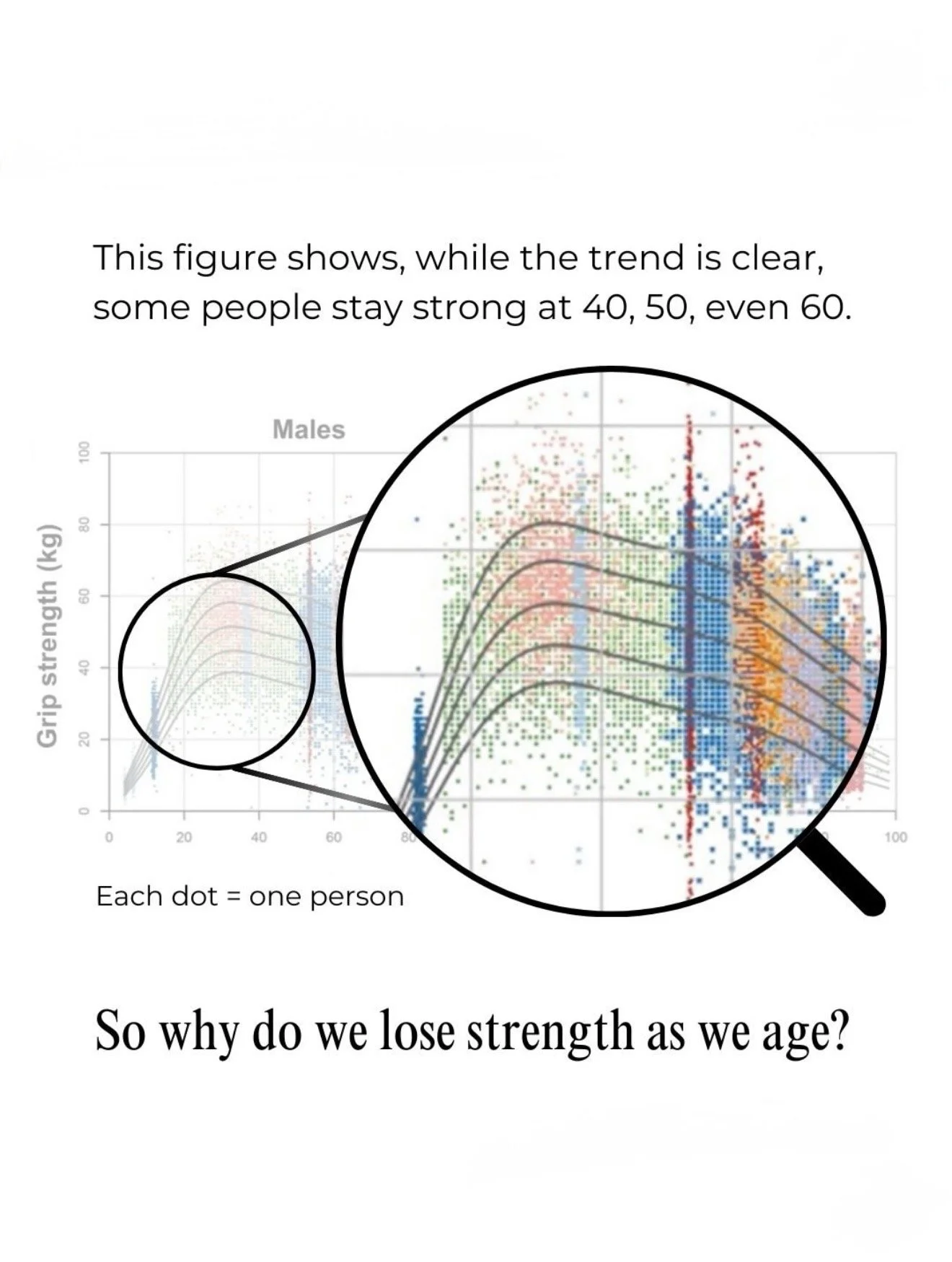
At every age — 40, 50, even 70 — there is huge variation.
Some people remain exceptionally strong well into later life, while others decline rapidly.
Age sets the backdrop.
Behaviour determines the outcome.
The Critical Detail Most People Miss
If ageing itself caused strength loss, everyone would decline at roughly the same rate.
They don’t.
The strongest individuals in their 60s are often stronger than untrained individuals in their 30s. That alone should tell us something fundamental: strength loss is conditional, not inevitable.
To understand why, we need to look at what actually changes inside the body.
What We Really Lose With Age
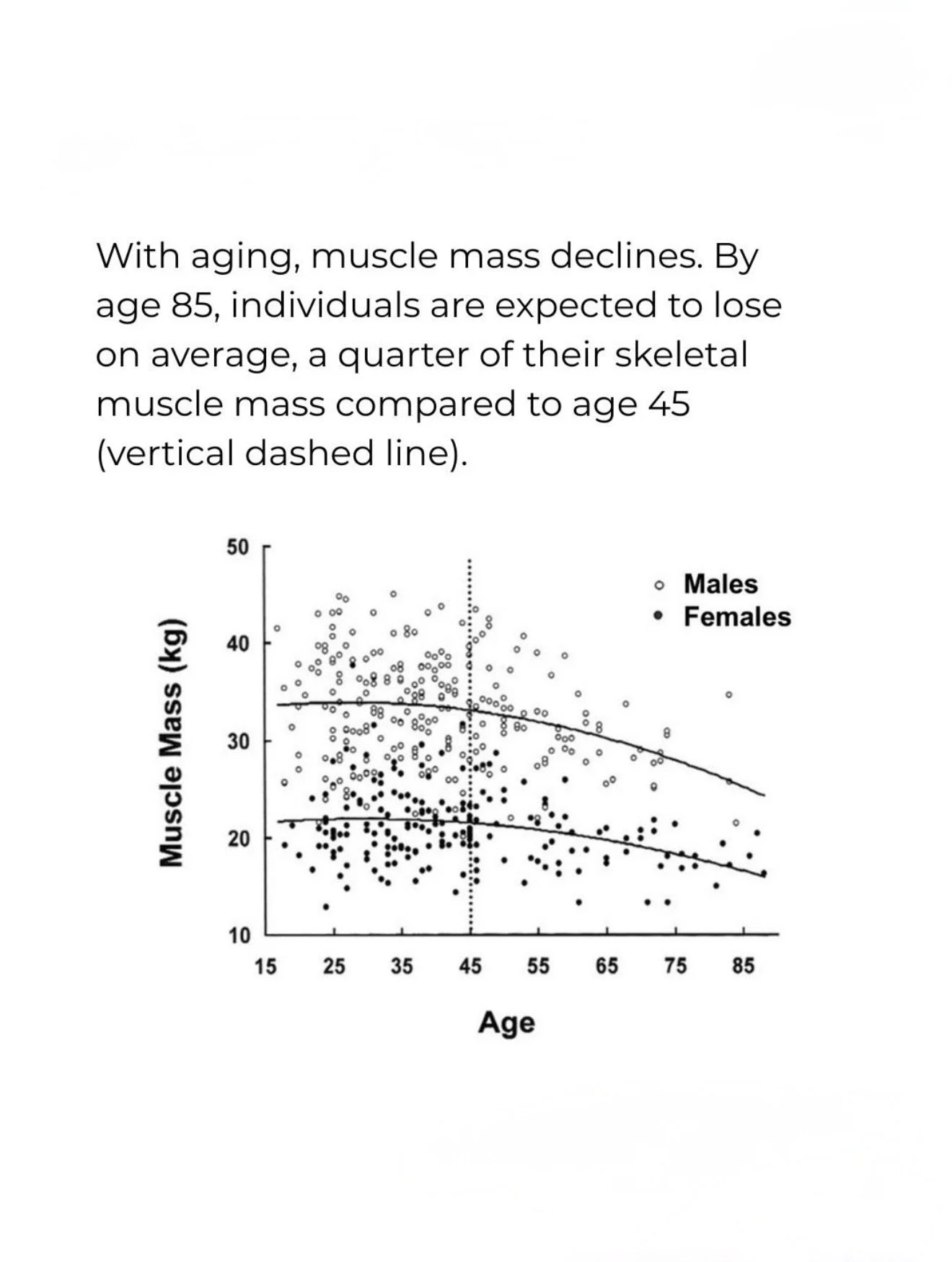
Strength loss isn’t just about muscle getting smaller. In fact, that’s the least interesting part.
Muscle Fibre Changes
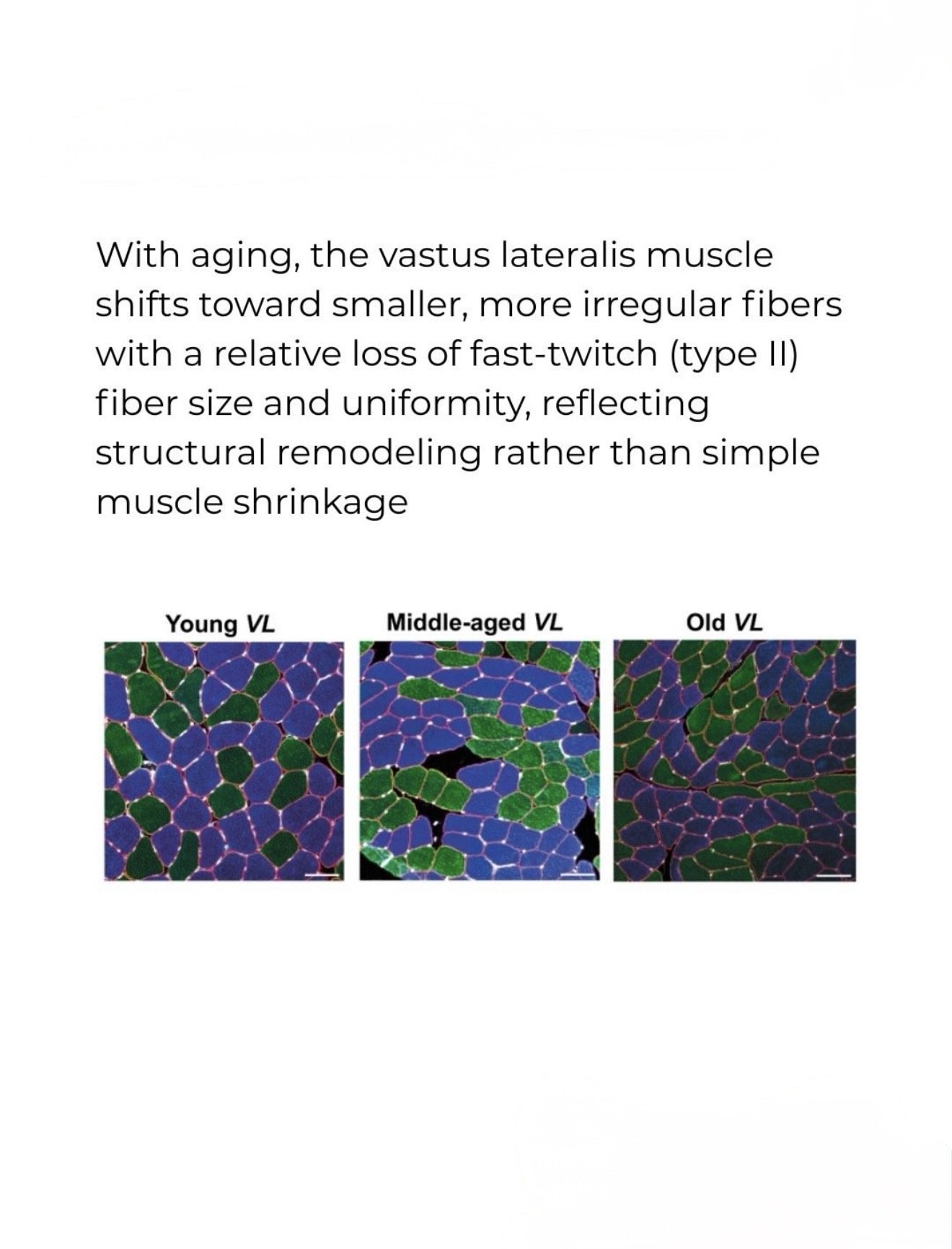
As we age, muscle tissue undergoes structural remodelling. Research examining muscles such as the vastus lateralis shows a shift toward smaller, more irregular fibres, with a disproportionate loss of fast-twitch (Type II) fibres.
These fibres are responsible for producing high force quickly. They’re the fibres you rely on when you stand up from the floor, catch yourself from a stumble, or generate power.
This change isn’t simply shrinkage — it’s a loss of quality and organisation.
Neural Decline
Strength is not just muscle. It’s the nervous system’s ability to recruit that muscle effectively.
With ageing, we see:
Reduced motor unit firing rates
Slower rate of force development
Less efficient recruitment of high-threshold motor units
This is why people often say, “I don’t feel weak, just unstable or slow.”
That’s a nervous system problem, not a motivation problem.
Muscle Quality, Not Just Mass
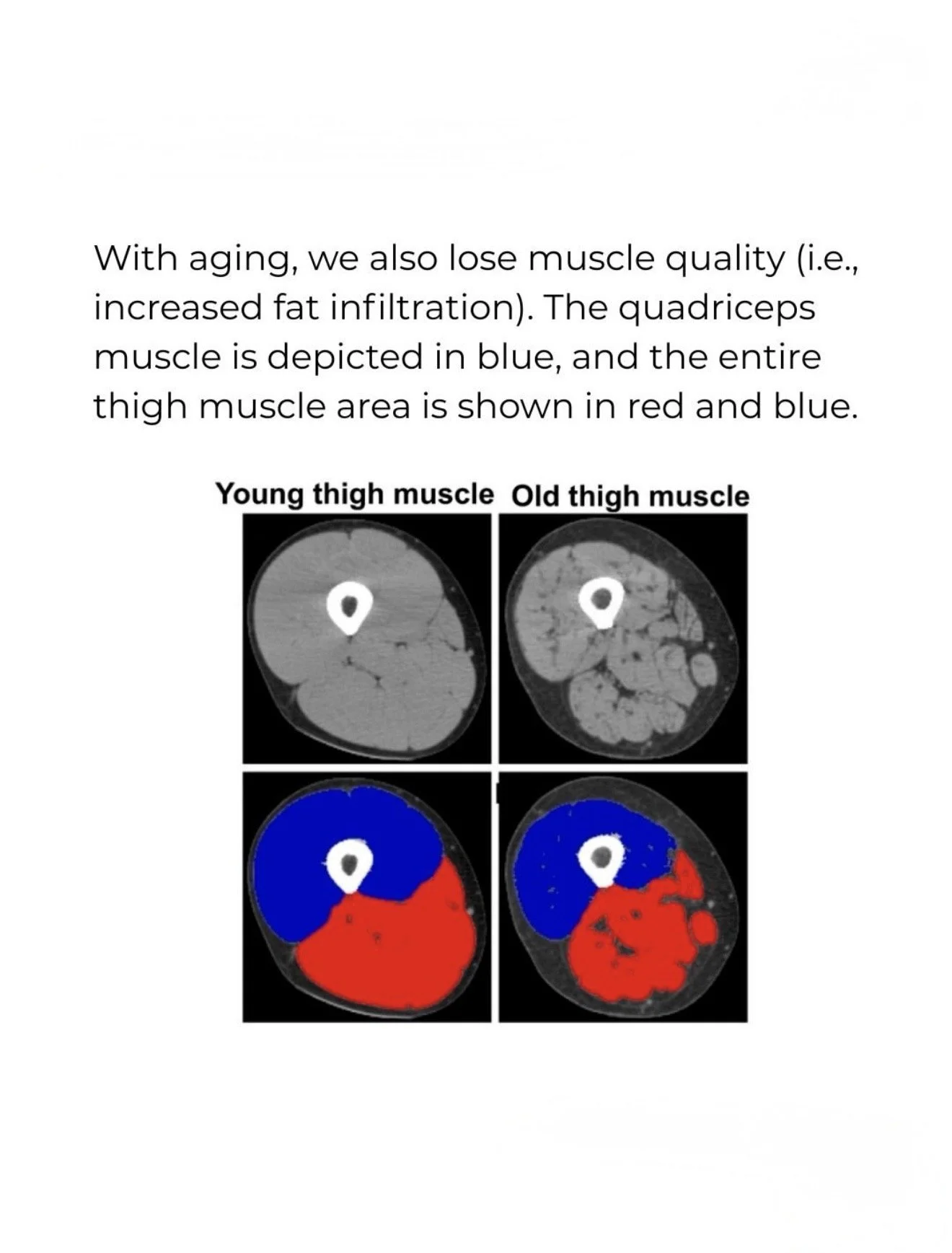
Imaging studies add another layer. Older muscle often contains significantly more intramuscular fat, even when overall size hasn’t changed dramatically.
Two thighs can look similar in size but behave very differently. One produces force efficiently; the other doesn’t.
Strength loss is about what the tissue can do, not just how much of it there is.
The Underlying Cause: Loss of Demand
Here’s the uncomfortable truth.
Most people stop asking their muscles and nervous system to do difficult things.
They stop lifting heavy enough to challenge force production.
They stop moving with speed or intent.
They replace loading with “safe”, gentle, or endlessly repetitive exercise.
Not because they can’t do more — but because they’re told they shouldn’t.
The body adapts perfectly to this reduced demand.
Remove the stimulus, and the capacity fades.
Why Some People Stay Strong Into Their 60s and Beyond
The same datasets that show average decline also reveal something hopeful.
People who maintain strength later in life almost always share the same training characteristics:
They continue to load muscles heavy enough to matter
They train consistently across years, not in short bursts
They retain some exposure to speed and intent
They don’t confuse “low risk” with “low effort”
Strength is a use-it-or-lose-it quality — and it remains trainable far longer than most people realise.
Strength Training as Ageing Insurance
Well-designed strength training doesn’t just slow decline — it changes the trajectory entirely.
Appropriate resistance training has been shown to:
Preserve muscle fibre size and structure
Maintain neural drive
Reduce fat infiltration into muscle
Improve balance, confidence, and coordination
Protect independence and quality of life
Importantly, this does not mean reckless training or maximal lifting.
It means progressive loading, intelligent exercise selection, and enough challenge to give the body a reason to adapt.
What Actually Works
Longevity training isn’t about chasing fatigue or burning calories. It’s about preserving the capacities that disappear fastest when neglected.
Effective strength training for ageing adults includes:
Loads heavy enough to challenge force production
Intentional effort rather than mindless movement
Some faster, controlled reps to preserve power
Year-round consistency, not stop-start programmes
This is not about ego or aesthetics.
It’s about remaining capable.
The Bottom Line
Age doesn’t make you weak.
Under-loading does.
Strength fades when the stimulus disappears — not because the calendar turns.
The body adapts to what you repeatedly ask of it, whether you’re 30, 50, or 75.
Ask very little, and it gives very little back.
Ask intelligently and consistently, and it responds far longer than most people expect.
Train with intent.
Lift with purpose.
And keep giving your body a reason to stay useful.
